

Kovar® alloy is the standard controlled-expansion material for glass-to-metal sealing and hermetic electronic packaging. EFINEA stocks Kovar® material in plate, sheet, round bar, rod, strip, and coil, with mill certification and full lot traceability on every shipment. Medical device, aerospace, defense, electronics, semiconductor, and scientific instrument manufacturers specify Kovar® alloy when a reliable seal between metal and glass or ceramic is required. ASTM F15 material is manufactured by multiple producers and may be available under different registered trademarks, including ASTM F15, UNS K94610, Pernifer® 2918, Dilver® P1, and NILO® K. Composition limits and properties are essentially identical across these names, and material supplied to ASTM F15 will meet the same specification regardless of mill or trade name.
For questions about whether Kovar alloy fits your design, our sales engineers and metallurgists are reachable at 800-348-6268.
Kovar® Alloy Forms Available from EFINEA
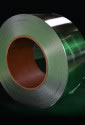
EFINEA stocks Kovar alloy in four primary wrought forms: plate, round bar and rod, sheet, and strip and coil. Each form supports a different family of applications, and all stock material ships with mill-certified traceability to the original mill. Procedural testing on incoming stock confirms uniformity of thermal expansion, transformation behavior, cupping for drawability, Rockwell hardness, grain size, gas content, and glass sealing performance.
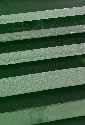
Kovar® Plate
Kovar plate is flat-rolled stock available in thicker cross-sections than sheet metal, with standard thicknesses stocked to ASTM F15. EFINEA also offers custom waterjet, shearing, and saw cutting, with plate typically supplied annealed for improved machinability and dimensional stability.
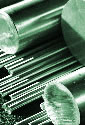
Kovar® Round Bar and Rod
Kovar round bar and rod are available for machined feedthroughs, headers, pins, and other turned components. EFINEA performs ultrasonic testing and microscopic examination of bar ends to verify material soundness and identify internal voids that could affect component integrity.
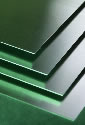
Kovar® Sheet
Kovar sheet is the standard form for stamped, formed, and deep-drawn components, with good drawability supporting close production tolerances. EFINEA stocks Kovar sheet in standard gauges and performs surface inspections to identify defects that could affect sealing or subsequent plating.
Why Choose EFINEA Metals as Your Kovar® Alloy Supplier
EFINEA Metals has supplied controlled-expansion alloys to high-technology industries since 1965. As a Kovar material supplier with inventory across four ISO 9001:2015 and AS9100D-certified facilities in New Jersey and California, EFINEA ships standard stock within 24 hours of order confirmation.
- AS9100D and ISO 9001:2015 quality systems with full lot traceability on every shipment
- Four warehouse and processing locations across New Jersey and California, each designed to prevent environmental damage to inventory
- In-house precision cutting, shearing, slitting, and waterjet services for prototype quantities and production runs
- Mill certifications included with every order, documenting heat and lot numbers, chemical composition, mechanical properties, and any applicable inspection results
- On-staff metallurgists and sales engineers for grade selection, specification interpretation, and fabrication guidance
- Procedural testing on incoming Kovar stock for thermal expansion uniformity, transformation behavior, drawability cupping, Rockwell hardness, grain size, gas content, and glass sealing performance
- More than 60 years supplying specialty metals, with deep coverage on Kovar and the broader controlled-expansion alloy family
As a Kovar alloy supplier and distributor, EFINEA accepts orders of any size, from research and prototype quantities through production runs supporting hermetic package and electronic component manufacturers.
What Is Kovar® Alloy?
Kovar is an iron-nickel-cobalt alloy with a nominal composition of approximately 29% nickel, 17% cobalt, and balance iron.
The composition is held to tight tolerances under ASTM F15 (UNS K94610) because the alloy’s defining property, a thermal expansion coefficient closely matching borosilicate glasses and alumina ceramics across the room-temperature-to-450°C range, depends on careful control of the iron-nickel-cobalt ratio.
Kovar® Properties and Applications
For full property tables (thermal expansion coefficient by temperature range, physical and mechanical property data, chemistry, specifications, and material behavior) and detailed application coverage across hermetic packaging, vacuum tubes, microwave components, integrated circuit packages, and aerospace electronics, see our dedicated Kovar® properties and applications page.
The short version: Kovar’s expansion coefficient matches borosilicate glasses and alumina ceramics closely enough to form stress-free hermetic seals across the operating temperature window. The alloy is porosity-free, deep-drawable, and machinable with standard tooling adapted for slow-feed work on controlled-expansion alloys. Common end uses include integrated circuit flatpack and dual-in-line packages, microwave tube housings, X-ray tube components, vacuum tube envelopes, power transmitter components, navigational equipment, and medical electronic device packaging.
For machining guidance specific to controlled-expansion alloys, see the EFINEA Machining Guide for Controlled Expansion Alloys. For comparison of Kovar against other controlled-expansion alloys EFINEA stocks, see our Thermal Expansion Table.
Glass-to-Metal Sealing
Expansion behavior is what makes Kovar the standard material for stress-free glass-to-metal seals. When a metal lead passes through a glass envelope (the classic configuration for vacuum tubes, hermetic packages, electronic feedthroughs, and X-ray tube envelopes), any mismatch in expansion between the metal and glass produces stress at the seal as temperature changes. Stress cracks the glass, compromises the seal, and ends the part’s service life.
Kovar’s expansion curve closely tracks that of borosilicate glass, ensuring the seal remains intact through repeated thermal cycling. The alloy is also produced as porosity-free stock that supports the deep drawing, stamping, machining, and forming operations needed to fabricate hermetic packages.
Kovar’s Curie temperature sits at approximately 435°C, well above typical electronic operating ranges. The alloy is ferromagnetic across its service window.
The Discovery and History of Kovar®
Kovar was developed at Westinghouse Electric & Manufacturing Company in the 1930s, with the founding patent issued in 1936 to Howard Scott. His objective was practical: vacuum tubes and other early electronic devices required reliable feedthroughs where electrical conductors passed through glass envelopes, but the metal-to-glass seals available at the time failed under repeated thermal cycling.
Scott’s nickel-iron-cobalt formulation was the first commercially viable stress-free glass-to-metal sealing alloy. The composition allowed engineers to design hermetic packages that could operate across wide temperature ranges without seal failure. Kovar enabled rapid advancement in radio, television, radar, microwave electronics, semiconductor packaging, and medical electronic devices.
Nearly a century later, the alloy remains in active production with the same nominal composition Scott patented, and ASTM F15 is the controlling specification today.
Frequently Asked Questions About Kovar® Alloy
Kovar is most often nickel- or gold-plated for hermetic electronic packages. Nickel plating provides a corrosion-resistant base layer that protects the parent alloy from oxidation and improves wettability during subsequent solder or braze operations. Gold plating is applied over the nickel for wire bonding pads, mating surfaces, lead frame fingers, and applications where solderability and contact resistance are critical. Plating also masks the darker, oxidized surface that Kovar can develop during glass sealing furnace cycles.
Store Kovar indoors in a dry environment to prevent surface oxidation. The alloy is not stainless and will develop a thin oxide layer if exposed to humidity over extended periods, which can interfere with glass sealing and plating operations. For long-term storage, light oil coatings or VCI packaging are typical. Each of EFINEA’s four warehouse locations is purposefully designed to prevent environmental damage to inventory before shipment.
Yes. Kovar is readily welded by GTAW (TIG), GMAW (MIG), electron beam, laser, and resistance welding processes. Weld procedures should control heat input and shielding to minimize segregation of cobalt and nickel within the weld zone, and post-weld stress relief is sometimes specified for components that will see subsequent glass sealing operations. Filler metals matching the parent chemistry are commercially available for processes that require them.
EFINEA is a leading supplier of Kovar® – ASTM F15 Alloy. A controlled expansion, glass-to-metal sealing alloy that is also known as Pernifer® 2918, Dilver® P1, Nilo® K.
Dilver is a registered trademark of Aperam Alloys Imphy, France
Kovar is a registered trademark of CRS Holdings LTD., Delaware, USA
NILO is a registered trademark of Huntington Alloys Corp., West Virginia, USA.
Pernifer is a registered trademark of VDM Metals GmbH, Germany