

EFINEA Metals is a global molybdenum supplier serving high-technology industries. Molybdenum is a refractory metal valued for its very high melting point of 2620°C (4748°F), low vapor pressure, low coefficient of thermal expansion, and a very low creep rate at typical furnace temperatures. Its thermal expansion runs roughly one-third that of stainless steels, making it a preferred material wherever dimensional stability under heat is required. We stock molybdenum as plate, round bar, rod, sheet, coiled sheet, wire, and threaded rod and nuts, with precision cutting available to your specifications.
Molybdenum Properties
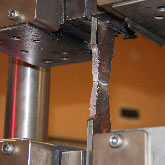 EFINEA is a leading global supplier of Molybdenum. Molybdenum offers a high melting point and low vapor pressure. Due to its high melting point, it offers a very low creep rate at typical furnace temperatures. The thermal expansion characteristics of Molybdenum are approximately one-third of stainless steels.
The tables below contain the physical, mechanical, chemical, and specifications for Molybdenum. Please contact the sales team at EFINEA if you have any questions or need additional information.
For an EFINEA Molybdenum datasheet, or any other Refractory Metals & Alloys datasheets, please navigate to the Data Sheets section in our Technical Library.
Typical Physical Properties
Molybdenum’s physical properties describe how the metal behaves as a bulk material under heat and electrical load. The high melting point and low coefficient of linear thermal expansion (5.2 × 10⁻⁶ m/m·K at 20°C) let components hold tight tolerances across wide temperature swings. A thermal conductivity of 142 W/m·K moves heat away from concentrated sources such as electrodes and heat-zone hardware, while the low specific electrical resistance suits molybdenum to current-carrying parts.
The recrystallization temperature shown reflects the point at which the worked grain structure changes, which affects strength after prolonged heating.
Molybdenum Typical Physical Properties | ||
|---|---|---|
| Density | g/cm3 | 10.22 |
| Melting Point | °F | 4748 |
| °C | 2620 | |
| Specific Electrical Resistance | (Ω∙mm2)/m | 0.056 |
| Specific Heat @20°C | J/(gK) | 0.254 |
| *Recrystallization Temp | 1100 | |
| Thermal Conductivity @20°C | W/(m-K) | 142 |
| Coefficient of Linear Thermal Expansion @20°C | m/(m-K) | 5.2x10⁻⁶ |
| *Temp C for 100% recrystallization. One hour annealing time. Deformation level + 90%. Source: Plansee | ||
Typical Mechanical Properties
Mechanical properties show how molybdenum responds to applied force, and they depend heavily on whether the material is stress relieved or fully recrystallized. In the stress-relieved condition, molybdenum sheet reaches roughly 800 MPa tensile strength at 20°C, with hardness above 220 HV10. Recrystallized material gives up some room-temperature strength in return for higher elongation, which can aid forming.
The values below come from 2mm sheet tested in the longitudinal direction and give a useful baseline for design, though final performance varies with section size, temper, and service temperature.
Molybdenum Typical Mechanical Properties |
|||
|---|---|---|---|
| Stress Relieved | Recrystallized | ||
| *Tensile Strength Rm | MPa-20°C | 800 | 500 |
| MPa-1000°C | 230 | 150 | |
| MPa-1400°C | 60 | 60 | |
| *Elongation | %-20°C | 20 | 50 |
| %-1000°C | 10 | 40 | |
| %-1400°C | 40 | 40 | |
| Typical Hardness | HV10 | >220 | 160-180 |
| Modulus of Elasticity | |||
| @20°C | GPa | 320 | |
| @2000°C | GPa | 160 | |
| *2mm sheet, longitudinal direction. Source: Plansee | |||
Chemical Composition
Molybdenum supplied to ASTM B386 and B387 Type 1 is unalloyed at greater than 99.95% purity, with interstitial elements such as carbon, oxygen, and nitrogen held to very low limits. These interstitials are controlled because they affect ductility and the ductile-to-brittle transition behavior of the metal.
Molybdenum Chemistry % |
|
|---|---|
| Carbon, max. | 0.010 |
| Oxygen, max. | 0.0070 |
| Nitrogen, max. | 0.0020 |
| Iron. max. | 0.010 |
| Nickel, max | 0.005 |
| Silicon, max. | 0.010 |
| Molybdenum, Balance | >99.95 |
| Source: ASTM B386 & B387 Type1, Table 1 Chemical Requirements | |
Every molybdenum shipment from EFINEA includes mill certifications, and chemistry can be verified with handheld XRF equipment at our warehouses when documentation traceability is critical to the program.
Specifications
Molybdenum from EFINEA is supplied to recognized industry standards, which lets engineers specify material with confidence for regulated work. Plate and sheet follow ASTM B386 Type 361, round bar follows ASTM B387 Type 361, and aerospace procurement often references AMS 7800.
The UNS designation R03610 and CAS number 7439-98-7 identify the material for cataloging and safety documentation.
Molybdenum Specifications |
||||
|---|---|---|---|---|
| ASTM B386 Type 361 (Plate + Sheet) | ASTM B387 Type 361 (Round Bar) | AMS 7800 | UNS R03610 | CAS 7439-98-7 |
For additional background, the websites of ASTM International and ASM International publish the full technical standards governing molybdenum. If you are working from an older drawing that references a superseded designation, contact our sales team for assistance with the cross-reference.
Molybdenum Applications
Molybdenum applications concentrate in environments that combine high temperature with a requirement for dimensional stability, low vapor pressure, or good thermal conductivity. The metal serves across aerospace and defense, electronics, and high-temperature furnace industries, and the specific form (plate, sheet, rod, wire, or threaded hardware) is usually driven by the application.
EFINEA supplies the highest quality special purpose metals and alloys for Aerospace/Aviation, Defense, Electronics, Magnetic, Medical, Lighting, Optical, Telecommunications, Ceramics, Heat Treating and other high-technology industries.
Aerospace and Defense
In aerospace and defense, molybdenum is specified for components that see extreme heat and mechanical load. Applications include nose cones, high-temperature structural parts, rocket nozzles, leading edges of control surfaces, support vanes, re-entry cones, and heat radiation shields.
The metal holds strength and shape at temperatures that would compromise conventional aerospace alloys, which is why it appears in propulsion and hypersonic hardware where thermal margins are tight.
X-Ray and Medical Imaging
Molybdenum is a longstanding material in X-ray tube construction, serving as anode substrates, rotating anode bodies, and precision collimators used in X-ray detectors. Its high melting point handles the intense localized heating at the anode focal spot, and its density supports the collimation of radiation beams in imaging and inspection equipment.
Threaded Hardware for High-Temperature Assemblies
Molybdenum threaded rod and nuts allow furnace and high-temperature assemblies to be fastened with hardware that shares the thermal behavior of the surrounding molybdenum structure. Using matched fasteners avoids the differential expansion problems that occur when high-temperature assemblies are bolted together with dissimilar metals.
Heating Elements
Molybdenum wire and rod are used in high-temperature vacuum and hydrogen-atmosphere furnaces to form resistance-heating elements. It carries current efficiently, tolerates repeated thermal cycling, and maintains its shape at operating temperatures where other heating element materials would sag or fail.
Electronics
The electronics market uses molybdenum for cathodes, magnetron end hats, x-ray tube components, filaments, and glass-to-metal seals. Two properties drive these applications: good thermal conductivity moves heat away from sensitive junctions, and the low coefficient of thermal expansion supports reliable seals to glass and ceramic.
Molybdenum is also specified as a substrate and heat spreader in power electronics and semiconductor packaging, where its expansion behavior can be matched to silicon and to compound semiconductors.
Power Tube Grids and Support Structures
Molybdenum wire is widely used in the construction of power tube grids and support structures that require high-temperature strength, low vapor pressure, and low thermal expansion. In these vacuum electron devices, the grid geometry must remain stable through operation, and molybdenum holds that geometry across the thermal range the tube experiences.
High-Temperature Furnaces
For high-temperature furnace work, molybdenum is effective in furnace boats, heat shields, windings, structural furnace members, and containers for components exposed to high temperatures.
Vacuum furnaces are a major application area, where molybdenum sheet and plate serve as heat-shielding and structural elements that enable efficient high-temperature processing. The low vapor pressure keeps it from contaminating the furnace atmosphere or the workpieces being processed.
Available Molybdenum Forms
EFINEA stocks molybdenum in a range of mill forms and can cut, shear, slit, or waterjet material to your drawing. Available forms include:
- Molybdenum Plate
- Molybdenum Round Bar | Rod
- Molybdenum Sheet
- Molybdenum Coiled Sheet
- Molybdenum Threaded Rod & Nuts
- Molybdenum Wire
Related molybdenum alloy grades: Molybdenum TZM and Molybdenum Lanthanum Oxide.
Why Source Molybdenum from EFINEA Metals?
EFINEA Metals has supplied refractory metals to high-technology industries since 1965. As established molybdenum alloy suppliers, EFINEA backs every order with material traceable to the original mill, including heat and lot numbers, chemical analysis, mechanical properties, and the applicable specification. Our facilities in New Jersey and California meet ISO 9001:2015 and AS9100D requirements, and we ship standard stock quickly to keep your projects on schedule.
Whether you need a single precision-cut plate or a recurring supply program, our team can help you select the right molybdenum grade and form for the job.
Frequently Asked QuestionsAbout Molybdenum
Yes. In air, molybdenum begins to form a volatile oxide above roughly 400°C, and oxidation accelerates as the temperature climbs. This is why molybdenum heating elements and hot-zone parts run in vacuum, inert, or reducing atmospheres rather than open air. In those protected environments, the metal holds up well across long, repeated heat cycles.
Both are refractory metals with high melting points, but molybdenum is lighter, easier to machine, and has higher thermal conductivity relative to its density. Tungsten has an even higher melting point and greater density, making it a good choice for the most extreme temperatures and radiation shielding. Many buyers choose molybdenum when they want refractory performance with better fabricability and lower weight. EFINEA supplies both, so we can help you weigh the trade-offs for your part.
Molybdenum can be joined by mechanical fastening (including matched molybdenum threaded rod and nuts), brazing, and certain welding processes. Welding is challenging because the weld and heat-affected zone tend to be brittle, so mechanical joining and brazing are often preferred for structural assemblies. The right approach depends on the service temperature and load requirements.
Molybdenum can be machined with the right tooling and technique, and its low interstitial content helps with joining, though the metal’s ductile-to-brittle transition requires care during forming and welding. See our Machining Molybdenum guide for practical recommendations, and contact us if you have questions about a specific operation.